
Basics of STI measurements
There’s a lot of content online about STI and STIPA measurement. This article serves to provide a simple summary of everything you need to know in order to measure and determine the intelligibility of speech through a public address system.
Some short facts about STIPA measurements:
- STI = Speech Transmission Index
- STIPA = Speech Transmission Index for Public Address Systems – a simplified method for measuring STI
- A standardized method to determine speech intelligibility
- Most widely accepted method in the world
- Measures how well a spoken announcement can be understood by human listeners
How does the measurement work?
For the STI Measurement, you play a test signal through a PA system, and you measure the signal with your sound level meter. The signal sounds a bit like a recording of a windy day.
-
Example of test signal
The sound is, however, not as random as wind. In fact, it contains precise modulations. The sound level meter is configured to look for these specific modulations. If there is some distortion in the PA system or background noise or reverberation present in the room, it will affect the modulations, which will be detected by the sound level meter.
Thus, you can determine how well the modulated signal has been received through the PA system at the position of the sound level meter, by comparing the original signal with the received signal. The result is shown on a scale from 0 to 1 where 0 represents a bad signal that is not understandable at all and 1 stands for excellent intelligibility. The duration per measurement is standardized and takes 15 seconds.

Scale showing the quality of the STI measurement
How to measure STI
A STIPA Measurement does not require a lot. You need to simply switch ON the test signal and stand at the place where you want to determine the STI. Now you just need to execute the measurement with the sound level meter. For reading and analysing the data a reporting tool is recommended; I’ll come back to this later.
As you can see, you do not need a lot of equipment to perform a STIPA Measurement. Practice and the right tools are essential though.
Here is a Checklist of the essential tools you need:
- Sound Level Meter with STIPA Function
- Device that replays the STI Signal
- Tool for Reporting
Watch out for these
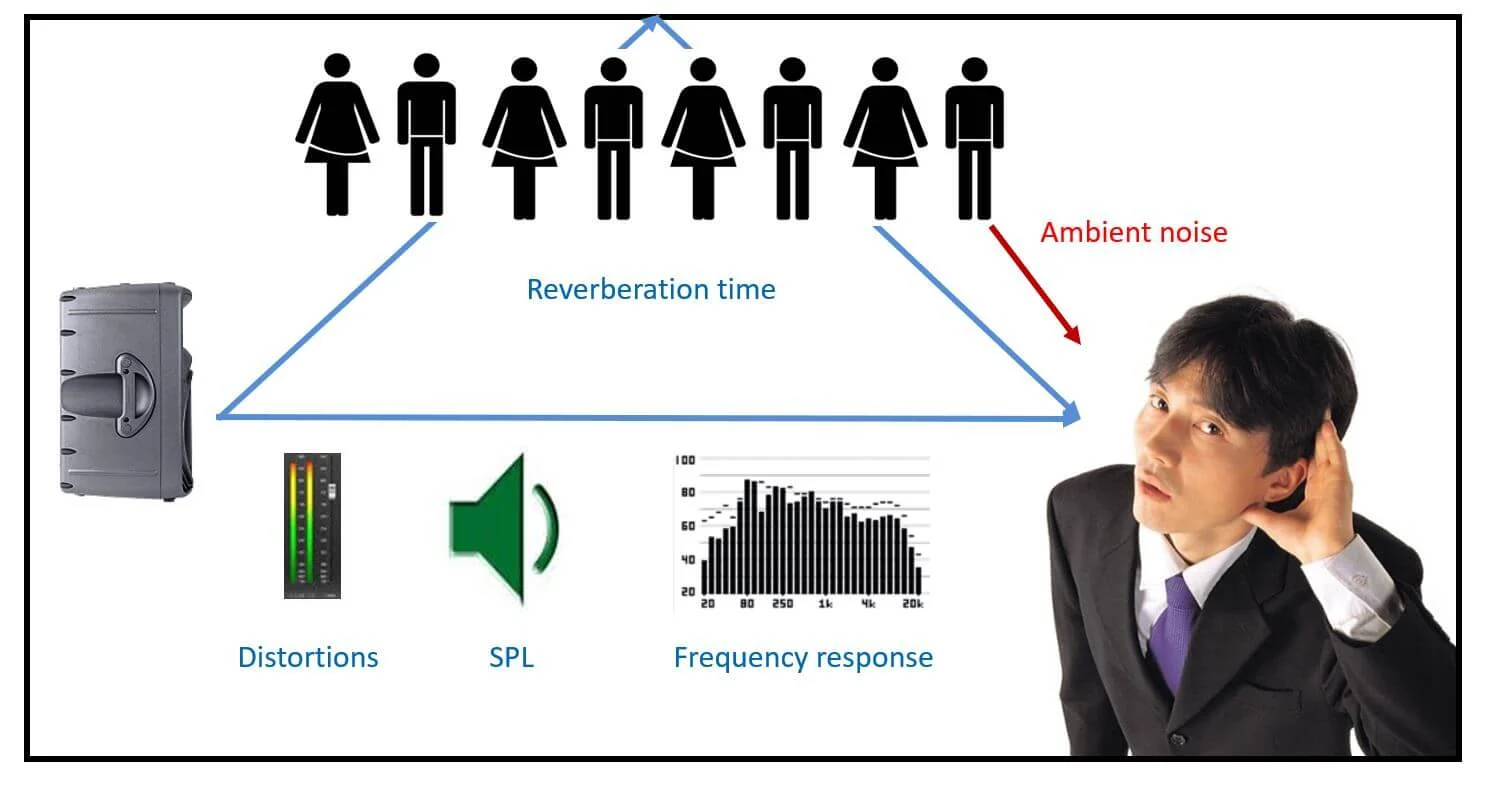
Factors that influence the intelligibility of speech
Factors that influence the intelligibility of speech are
- The quality of the PA system
- Sound pressure level (the announcement must be loud enough but not too loud)
- Ambient noise level (noise from crowds or passing traffic)
- Reverberation time RT60 (sound reflects off smooth surfaces; we need some reflections but not too many)
- Frequency response (e.g. too much bass muffles the announcement)
- Masking effects (the announcement is masked by another louder sound)
Also consider that people present in the room, while creating noise themselves, will also damp the signal as well as the noise.
How many measurements?
If you want to measure STIPA in a very large location you will have to repeat the measurement every 6 to 12 meters, depending on the room size. Also, you have to make sure that you are measuring STIPA at the appropriate places where people are usually standing or sitting when listening to the speeches and/or announcements. This way you will get a clear overall picture of the intelligibility at your location.
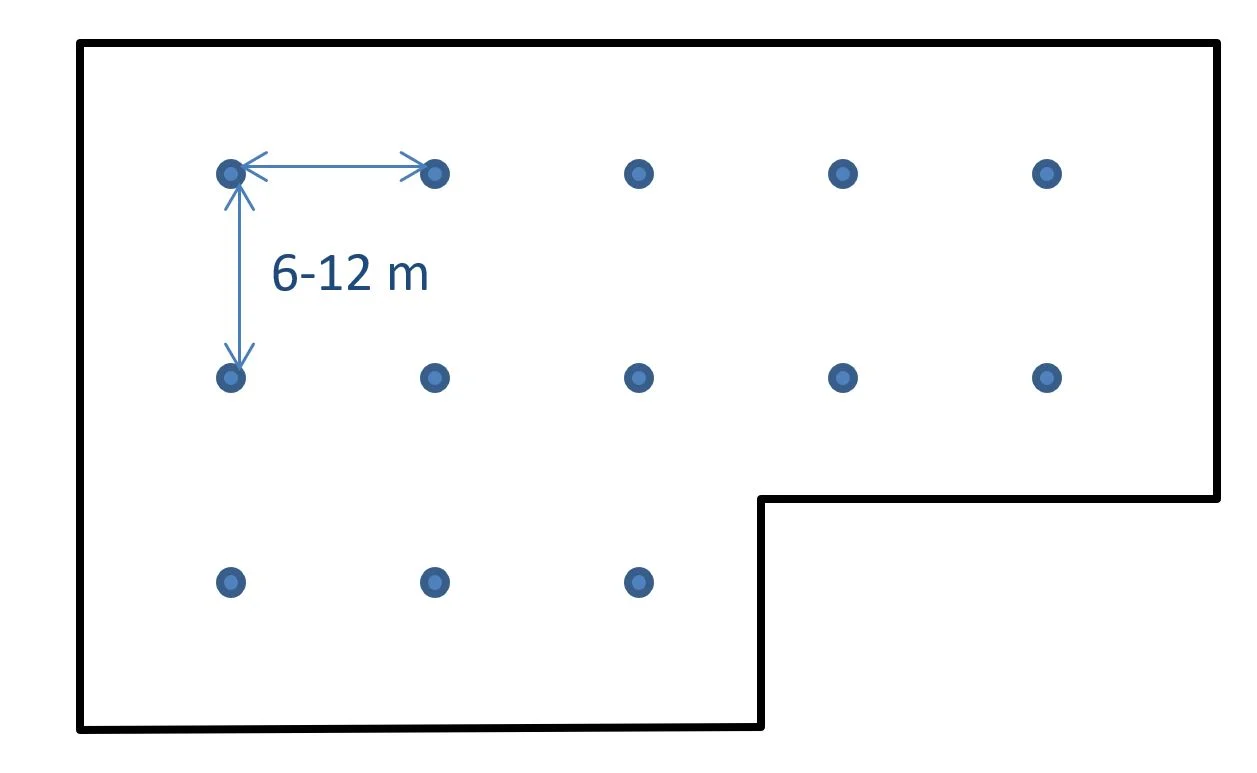
Distance of between STI measurement points for large rooms
Challenge to overcome
Public places often are crowded, which makes the Intelligibility of the announcements so important. For a consultant who has to perform the measurements, these conditions can be tricky.

Crowded hallways in an Exhibition Center
For example, imagine yourself standing in the middle of a crowd and trying to make a STIPA measurement. That would mean you need to replay the test signal through the PA system over and over again. This would be difficult for you to measure and the people will probably get annoyed very quickly at the loud, repeated, windy noise! Also, you have to be aware that the noise that is coming from the people will heavily affect your STIPA result as the STI measurement is quite sensitive to ambient noise and especially to impulsive noise. The crowd noise would compromise the accuracy of your STIPA measurement. On the other side you certainly want to reflect the impact of the crowd as you need to know how well a spoken announcement will be understood in the presence of a crowd.
The solution is quite simple and requires only three steps:
- First you go into the crowded room to measure just the ambient noise (The noise coming from the crowd). If you want, you can do this at several places at, say, 15-second intervals.
- Next you make the STIPA measurements, BUT you have to do this when the place is deserted. Nightshift?
- Finally, you combine both results, the ambient noise and the STIPA results in to the true STI result.
STIPA Standard IEC 60268-16
To measure meaningful STI you have to meet a Standard. Ensure that your sound level meter is capable of measuring to this standard. In Europe the standard is IEC 60268-16. There are 4 editions of this standard. Choose the latest edition unless the choice is specified by your employer.
Reporting the results
After completing the measurement, you now want to read and present if the results meet the standard. A professional-looking report is useful at this point. Such reporting tools are available as a free download depending on the sound level meter you used.
Links relevant to this topic: