Sound Level Measurements

Sound level measurements are important for understanding and managing the positive and negative effects of both sound and noise.
It is, for example, possible to measure the sound levels of music and other sounds that positively impact mood and well-being, and use this information to design environments that are more conducive to these positive effects.
There are also important reasons for measuring noise levels. Many countries have regulations that set limits on noise levels in different environments. These limits are in place to reduce the impact of noise pollution on human health and well-being.
A Sound Level Meter is the most common tool for measuring sound and noise levels.
- Sound is created when particles, such as air molecules, oscillate. In a vacuum, there is no sound. Humans are mainly concerned with oscillations at frequencies that trigger our hearing.
- Noise: There is no single definition of noise. The definition depends on the context, and on people’s culture, and it even changes over time. One person’s music may be another person’s noise. The most commonly-used definition is: “unwanted or disturbing sound“.
Where are Sound Levels Measured?
Sound Levels are measured in various environments.
Sound Level Meters have a wide range of further applications. They are employed in such diverse areas as Audiology, Music Production, Product Testing, Automotive Noise Testing, Acoustic Forensics, Sound Reinforcement System, Bioacoustics and Education.
To assess noise from other rooms or from the outside world in places such as offices, schools, and hospitals. The purpose of the rooms in these buildings should not be disturbed by such noise.
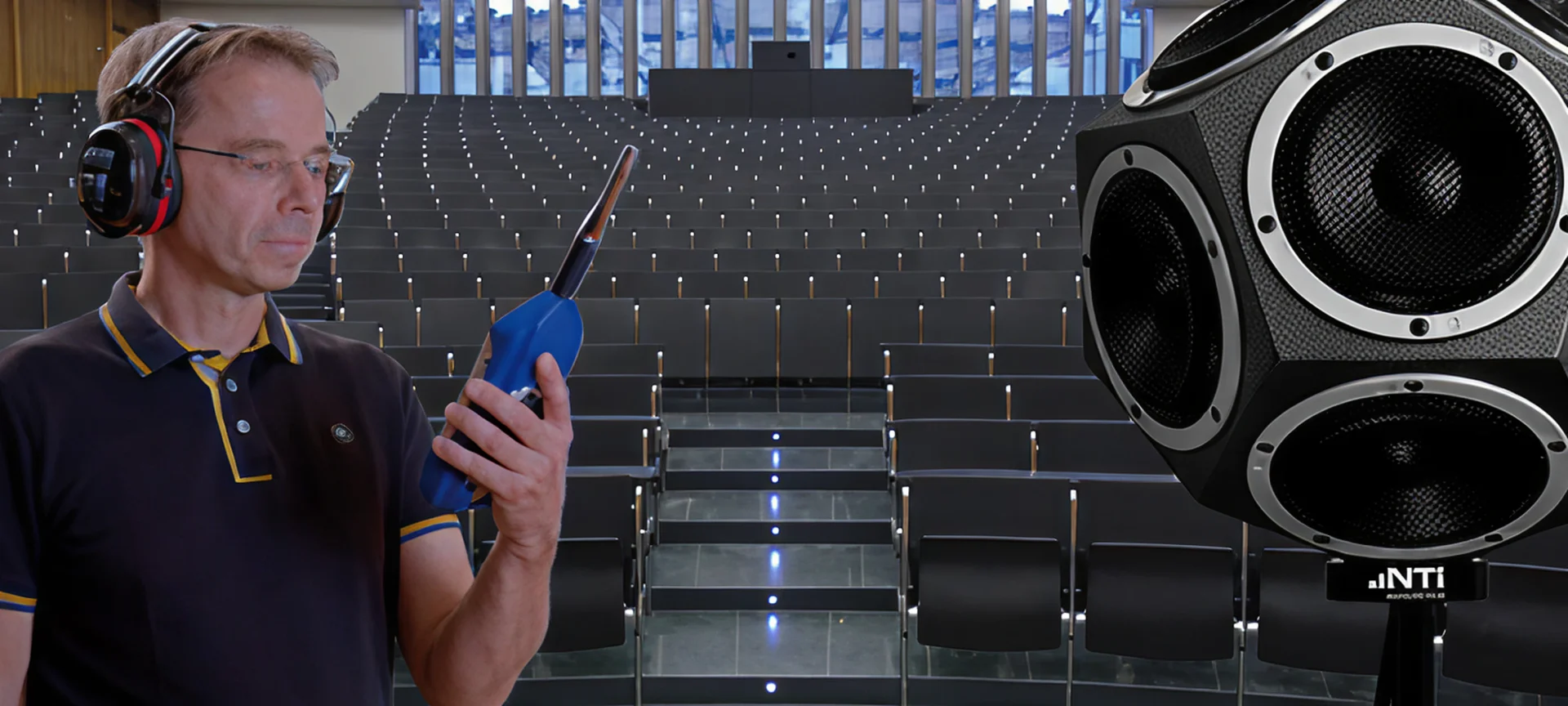
To assess the acoustic properties of closed spaces, such as meeting rooms, conference halls, classrooms, concert halls, recording studios, airports, and train stations. The space can then be designed to enhance the experience of listening to music or speech.
The sound levels at live events should not cause discomfort or damage to the audience’s hearing, nor disturb the neighbors.
To assess the impact of noise on the neighborhood and the environment.
- Construction noise: to monitor the noise levels from construction activities. This information can be used to ensure that noise levels are within acceptable limits and to protect the health and well-being of workers and residents.
- Industrial noise control: to assess noise levels from machinery and other industrial sources. This information can be used to reduce the levels to protect workers’ health and well-being and reduce the environmental impact of industry.
- Railway noise: to assess the impact of railway noise on communities. This information can be used to develop strategies to reduce railway noise, such as installing noise barriers or improving the design of railway vehicles.
- Airport noise: to assess the impact of airport noise on communities. This information can be used to develop strategies to reduce airport noise, such as installing noise barriers or changing aircraft flight paths and/or times.
- Traffic noise: to monitor the noise levels from traffic, and take steps to reduce them, for the benefit of residents in the area.


What is a Sound Level?
The Sound Pressure Level (SPL) is the most basic level used in sound measurements. The SPL, measured in Decibels (dB), has been widely used since the 1930s.
SPL is defined as the logarithm of the ratio of the sound pressure to a reference pressure
SPL = 20 log10(p/pref) dB
p → the instantaneous sound pressure in Pa
pref → the reference pressure = 20 µPa
There are a few common filters applied to the SPL, that make the reporting of levels more relevant and easier to compare. Applying these filters gives us the often-seen indicators, such as LAF, LCS, etc.
Common Filters
Frequency weighting
Frequency weighting is applied to account for how the human ear perceives sound. The microphone is much more efficient than human ears at detecting very low and very high frequencies. The weighting curve therefore reduces the low and high frequencies to make the sound more similar to that which a human would hear. Frequency weightings thus correlate the objective sound level meter measurements with the subjective human response. The three most popular are A, C, and Z.
Time weighting
Humans hear sound as an “average” over short periods of time, not as the rapidly-changing levels that are detected by the microphone. Time weighting is thus applied. The levels measured are also easier to read on a sound level meter as the time weighting dampens sudden changes in levels, thus creating a smoother display. Time weightings are defined by the period over which they are measured. The three most popular are S = Slow, F = Fast, and I = Impulse. Of these three, Slow is measured over the longest period.
There are further interesting ways to describe levels, depending on your application. Read about them here:
How does a Sound Level Meter work?
-
A Sound Level Meter (SLM) is an instrument that measures and quantifies the Sound Pressure Level (SPL) of sound.
Sounds (signals) pass through the SLM in the following order:
- Membrane: Sound waves vibrate the microphone membrane. This movement is converted into an electrical (analog) signal.
- Preamplifier: The preamplifier amplifies the analog signal.
- AD converter: Converts the analog signal to a digital signal.
- DSP: The DSP (Digital Signal Processor) shapes the digital signal with time and frequency weighting.
- Display: The display shows the resulting sound level.
Pattern Approval (type approval) and Class 1 Compliance under IEC 61672
Pattern approval is a fundamental concept in the IEC 61672 series and plays a central role in determining whether a sound level meter can legitimately be claimed as Class 1. While IEC 61672-1 defines the electroacoustical performance requirements for Class 1 and Class 2 sound level meters, it does not by itself constitute proof of compliance. Compliance must be demonstrated, and this demonstration is achieved through pattern evaluation tests as defined in IEC 61672-2.
Pattern evaluation consists of a comprehensive and standardized test campaign covering all mandatory requirements of IEC 61672-1, including electroacoustical performance, environmental influences (temperature, humidity, pressure), electromagnetic compatibility, directional response, linearity, time weightings, peak measurements, and uncertainty analysis. These tests are performed on representative specimens of the instrument and result in a formal pattern evaluation report, which documents the test methods, results, and associated measurement uncertainties.
To legitimately claim Class 1, a sound level meter must have successfully passed these pattern evaluation tests. A device that is merely “designed according to” IEC 61672-1, or that has only undergone partial or internal testing, cannot be considered Class 1 compliant in the normative sense.
Pattern evaluation tests are typically performed by national or accredited metrology institutes with the necessary expertise, facilities, and metrological traceability. In Europe and internationally, such tests are commonly carried out by organizations such as LNE (France), PTB (Germany), METAS (Switzerland), or CEM (Spain). These institutes operate within a national and international metrological framework and ensure full traceability to primary standards.
It is important to distinguish pattern approval from periodic verification according to IEC 61672-3. Verification tests, even when performed by an ISO/IEC 17025 accredited laboratory, only confirm that an individual instrument remains within tolerance at the time of testing. They do not validate the original design of the instrument and do not establish Class 1 conformity. Verification cannot replace pattern approval and cannot be used as evidence that an instrument meets all IEC 61672-1 requirements.
In contrast, pattern approval validates the design and performance of the instrument type itself. For regulatory applications, environmental noise monitoring, legal metrology, and high-stakes measurements, only pattern approval performed by a competent metrology body constitutes a robust and defensible demonstration of Class 1 compliance.
In summary, claiming Class 1 status without successful IEC 61672-2 pattern evaluation is not technically or normatively justified. Pattern approval is the cornerstone of credibility, comparability, and trust in professional sound level measurements.
Standards that define sound level measurements
Standards (noise regulations) relating to sound transmission are established through organizations who develop guidelines and recommendations for sound level measurements in various areas, including environmental, industrial, building, and room acoustics. These organizations include:
-
- American National Standards Institute (ANSI)
- International Organization for Standardization (ISO)
- European Committee for Standardization (CEN)
- International Electrotechnical Commission (IEC)
- International Commission for Acoustics (ICA)
These standards are adopted by national, state or provincial and municipal levels of government. They usually place restrictions on the amount of noise, the duration of noise, and the source of noise, as well as limiting to certain times of the day. These standards include:
- ANSI S1.4 – Specifications for Sound Level Meters.
- ANSI S1.11 – Specification For Octave-Band And Fractional-Octave-Band Analog And Digital Filters.
- IEC 61672 – Electroacoustics – Sound level meters.
- ISO 9612 – Acoustics – Determination of occupational noise exposure levels – Engineering method.
- ISO 1996 – Acoustics – Description, measurement and assessment of environmental noise.
- ISO 16032 – Acoustics – Measurement of sound pressure level from service equipment in buildings – Engineering method.
- ISO 3382-1 – Acoustics – Measurement of room acoustic parameters.
These are just a few of the many standards that define sound level measurements. The specific standard that should be used depends on the application.
Frequently Asked Questions
Use the XL3 or XL2 with a suitable measurement microphone and perform a quick acoustic calibration with a sound calibrator (typically 94 dB at 1 kHz) before and after the measurement session. This creates traceable results and helps catch setup or microphone issues early.