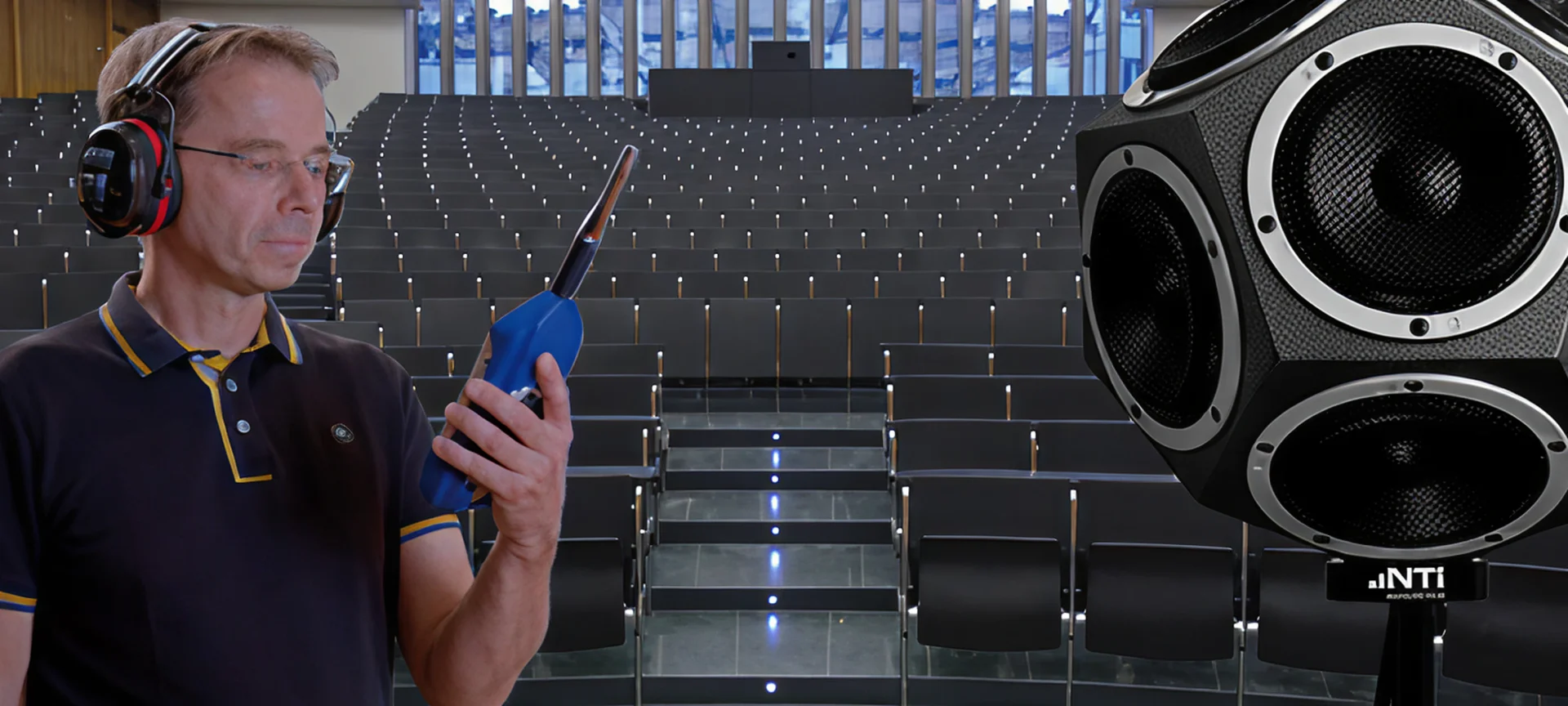
Building Acoustics Basics

What is Building Acoustics?
For the benefit and wellbeing of people in offices, schools, and homes, disturbing noise from other rooms or from the outside world should be kept to a minimum.
In order to optimize the sound insulation against external noise sources, standardized Building Acoustic measurements such as airborne and impact sound insulation have been established. Building Acoustics is thus distinguishable from Room Acoustics, which essentially deals with the acoustic properties within the room itself.
What do you measure?
Measure the sound insulation between two rooms. Do this by generating a sound in a room, and by comparing this sound level with the level measured in another, normally adjacent, room.
Airborne and impact noise are distinguished as follows.
- Airborne noise is sound that is transmitted through the air, such as traffic noise or people talking in the room next door.
- Impact noise results e.g. from footsteps on a floor, which can be heard in the room below.
The process of calculating the the sound insulation may also require that the Reverberation Time and the background noise (Noise Curves) are measured.


How to measure airborne sound insulation?
The measurement principle is simply to create a measured noise in the first room (the sending room) and compare that to a measurement in the second room (the receiving room).
- Generate a reference test signal (e.g. Pink Noise) in the sending room by using an omnidirectional loudspeaker.
- Measure the noise spectrum both in the sending and the receiving room.
- Correct the reading of the receiving room by deducting any disturbing background noise, and of the room effect (if the receiving room is reverberant, the sound level will be higher)
The airborne sound insulation of facades is measured in the same manner. In that case, the test signal source is positioned outside the building in the front of the facade partition under investigation.
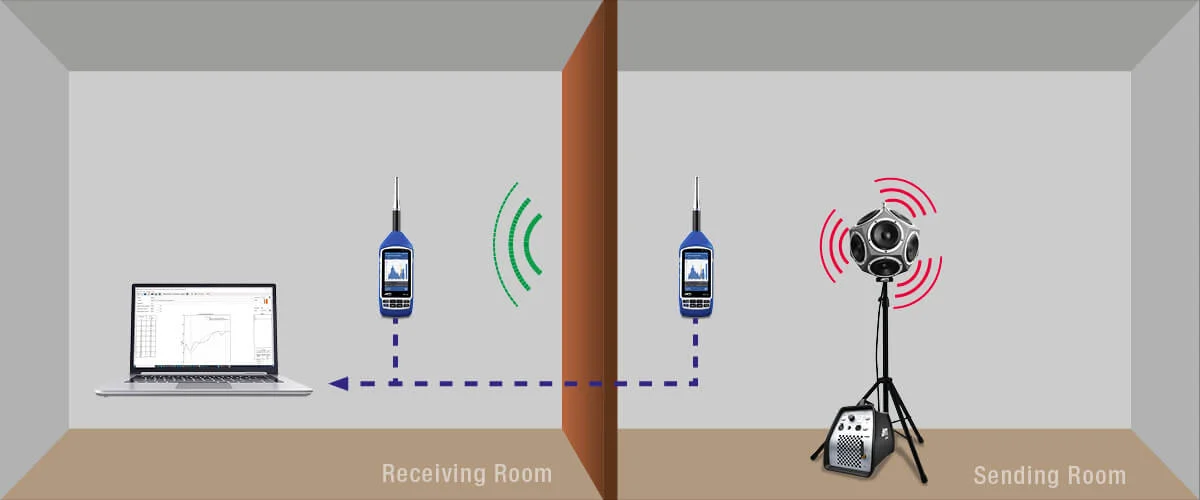
Airborne sound insulation measurement
How to measure impact sound insulation?
For impact sound insulation measurements, either a Tapping Machine or Impact Ball can be used as a source.
- Tapping Machine:
The TM EOS2 Tapping Machine produces the impacts on the floor to determine the impact sound insulation. The hammers in this PTB-approved precision instrument hit the ground at a prescribed rate and with a constant, measured force. The remote-controlled TM EOS2 is compliant with the standards that define building acoustics.
- Impact Ball:
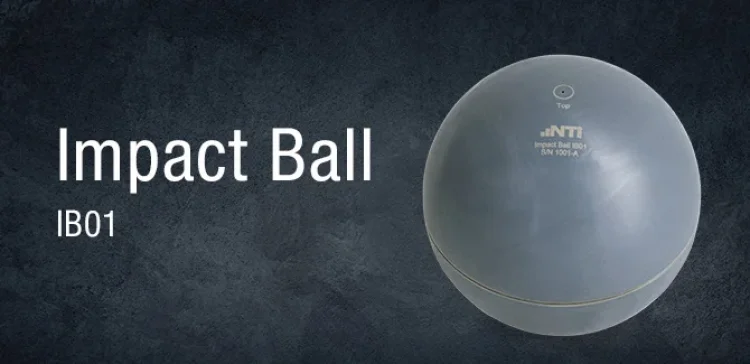
The Impact Ball IB01 is a lightweight, easy-to-use, and professional impact source for impact sound insulation measurements of floors and stairs, with an ideal performance for applications in wooden buildings, providing a highly accurate representation of human activities and low-frequency excitation.
The noise spectrum is measured in the receiving room.
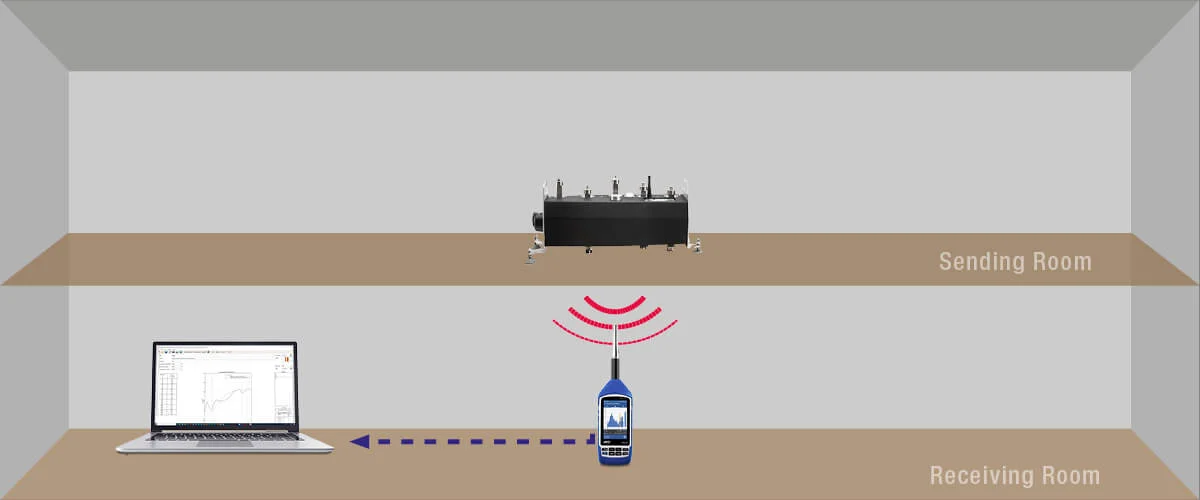
TM EOS2 Tapping Machine – Impact sound insulation measurement
In the Sending Room,
-
the Tapping Machine TM EOS2 is placed at several positions on the floor, or
-
the Impact Ball IB01 is dropped vertically from a height of 1 m (± 1 cm) at several positions.
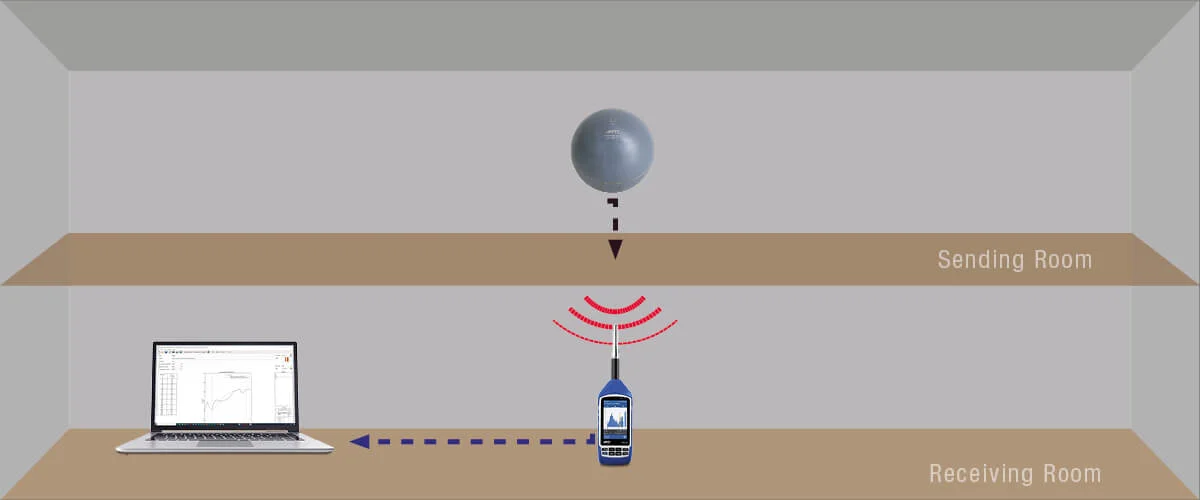
IB01 Impact Ball – Impact sound insulation measurement
The Sound Insulation Reporter PC Software or the XL3 Acoustic Analyzer allows you to correct the reading by deducting any disturbing background noise and reverberations.
How to measure façade sound insulation?
A façade is an exterior side of a building. The soundproofing principles are essentially the same as those for interior walls. When measuring façades, the sound source is positioned outside the building.
A pink noise is used as a test signal. You need a speaker that is powerful enough to produce the desired sound level in the frequency band from 50 Hz to 10 kHz as uniformly as possible.
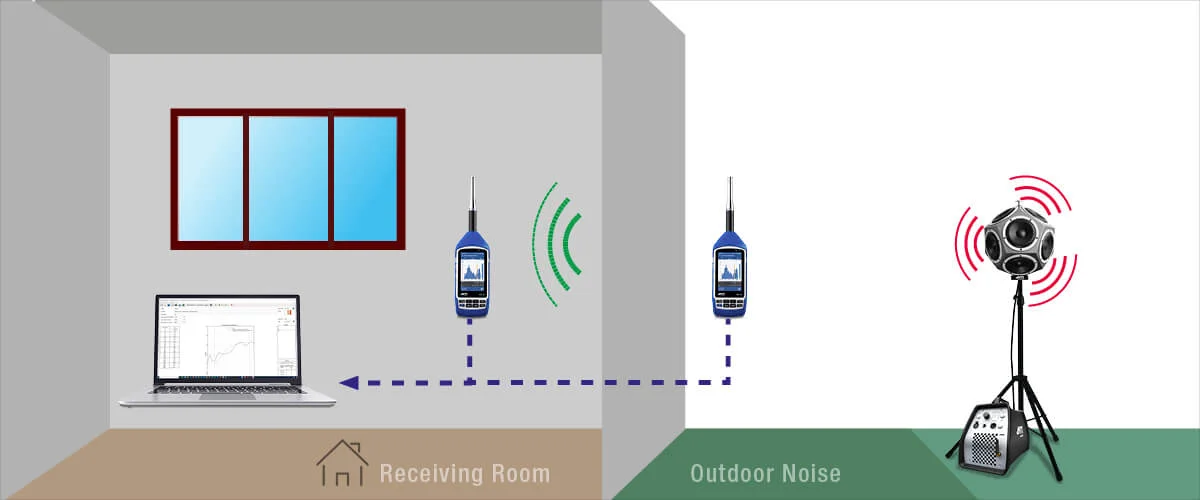
Façade sound insulation measurement
Which instruments do you need?
-
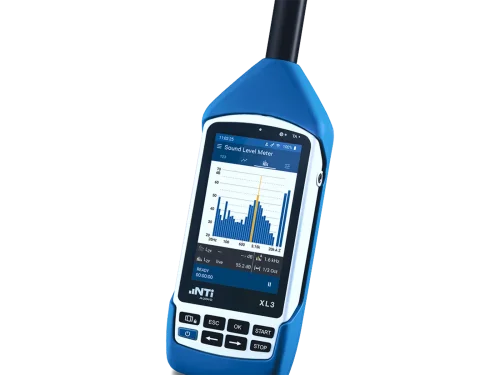
XL3 Sound Level Meter
The XL3 Sound Level Meter is capable of measuring the required acoustic parameters in accordance with the standards. These are the sound levels in the sending and the receiving room, the background noise and the reverberation time, which quantifies the room effect.
-
DS3 Dodecahedron Speaker Kit
The DS3 Dodecahedron Speaker, as a sound source for airborne sound insulation measurements, together with the PA3 Power Amplifier, meets all the requirements of the ISO 16283 standard. In addition, we offer impressive performance data; with a weight of only 7.5 kg and a typical sound power of 120.5 dB, the DS3 is convenient to carry around on site. By pressing a button on the supplied wireless remote control, the test signal can be comfortably switched on and off from outside the sending room.
-
Reporting Software
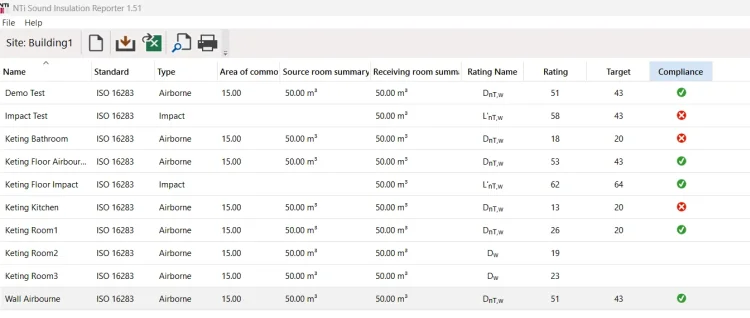
Using a professional software package for controlling the process and reporting the results certainly simplifies the task. The measurement results obtained by the XL3 Sound Level Meter can be easily imported into the Sound Insulation Reporter. This PC software then calculates the required results for the airborne and impact sound insulation in accordance with the selected standards.
Optional devices you may need
-
Tapping Machine
The TM EOS2 Tapping Machine produces the impacts on the floor to determine the impact sound insulation. The hammers in this PTB-approved precision instrument hit the ground at a prescribed rate and with a constant, measured force. The remote-controlled TM EOS2 is compliant with the standards that define building acoustics.
-
Impact Ball
The IB01 Impact Ball is a lightweight, easy-to-use, and professional impact source for impact sound insulation measurements of floors and stairs, with an ideal performance for applications in wooden buildings, providing a highly accurate representation of human activities and low-frequency excitation.
Shopping List
Standard Measurement Kit for Building Acoustics
- DS3 Dodecahedron Speaker
- Tripod for DS3 Dodecahedron Speaker
- PA3 Power Amplifier with built-in noise generator
- XL3 Acoustic Analyzer
- M2230 Measurement Microphone
- 1/2″ Windscreen 90 mm
- Class 1 Sound Calibrator
- XL3 Sound Insulation Bundle
Optional as required:
- TM EOS2 Tapping Machine
- IB01 Impact Ball
- Backpack for XL3
Our Solution
NTi Audio provides a streamlined, efficient workflow for building acoustics measurements, designed to reduce time on site while ensuring standards compliance. The system enables flexible measurement sequences, allowing users to take measurements in any order depending on site conditions, rather than following a fixed process.
A key advantage is the ability to reuse previously captured data, such as reverberation time, background noise, and source levels, across multiple tests. This minimizes redundant work and speeds up large measurement campaigns.
The solution also supports remote operation of multiple devices, allowing a single operator to control measurements in both sending and receiving rooms simultaneously. This significantly improves efficiency and reduces manpower requirements.
With instant on-site analysis, results are available immediately after measurement. This allows users to verify compliance and fix any issues before leaving the site, avoiding costly return visits.
Finally, integrated software tools automatically organize and process results, making it easy to manage even large projects and generate standardized reports quickly. Overall, the solution delivers faster workflows, fewer site visits, and reliable, standards-compliant results.
Where to next?
Further links for Building Acoustics
Frequently Asked Questions
Yes. The XL3 includes an integrated web server and file server for browser based control via Wi Fi or LAN, and measurement data can be downloaded while the measurement continues. XL3 can also be remotely used to perform Building Acoustics measurement using Sound Insulation Reporter Software.
Yes. With the STIPA Option installed, the XL3 or XL2 measure speech intelligibility according to IEC 60268-16:2020 (and also support older editions), including features like ambient noise correction and automated averaging.
Products used for Building Acoustics Basics
-
Sound Insulation Reporter
Learn morePC software for sound insulation measurements, analysis, and standardized reporting.

-
-

Downloads
- Software